
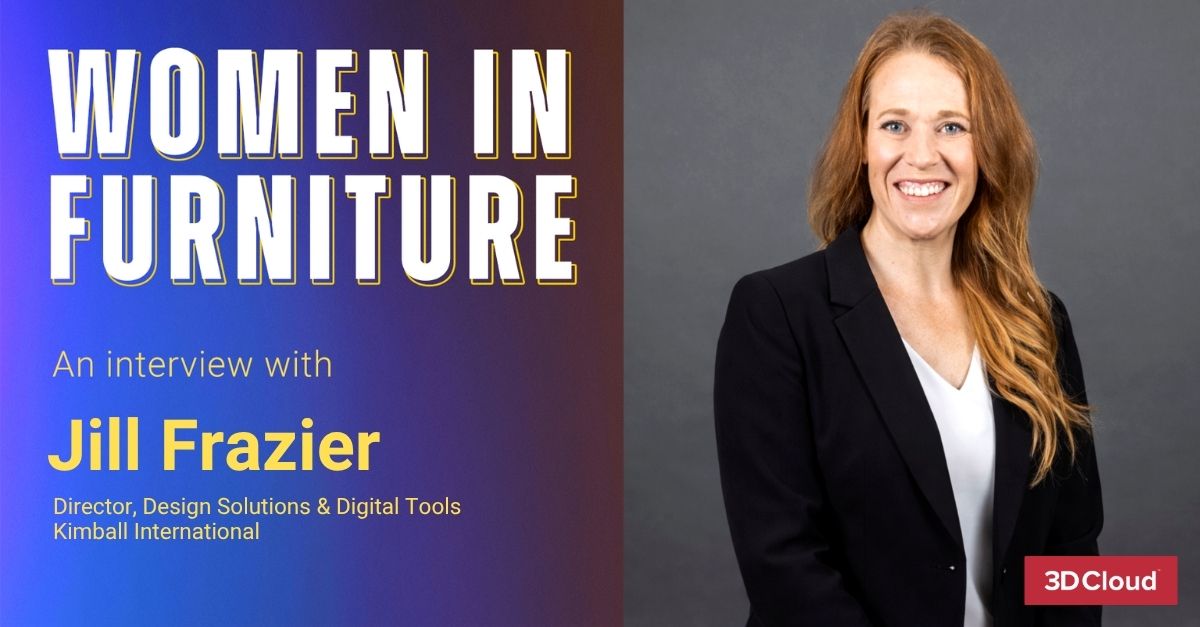
In celebration of Women’s History Month, we’re happy to bring our Women in Furniture Series, spotlighting accomplished women shaping the furniture industry. While strides have been made towards gender diversity, the industry lags behind others. At 3D Cloud®, we stand behind and empower outstanding women propelling the industry forward. So, grab your favorite brew, take a seat, and delve into the inspiring journey of —
Jill Frazier.
We can start with how you landed in the furniture industry. Can you tell us about that?
Jill Frazier: I landed in the furniture industry through a path that wasn’t especially traditional, but it ended up being the right fit. I’ve carved out a role at the intersection of design, digital tools, and dealer support — everything from design services and training to product configurators, eTools, and dealer activation. I was drawn to how this industry brings together creativity, technology, and relationships. Over time, I found a niche in helping connect those pieces in a way that makes it easier for our dealers and sales teams to move faster, work smarter, and ultimately win more business.
What steps did you take to become the Director of Design Solutions and Digital Tools?
JF: My path to becoming Director of Design Solutions and Digital Tools has been a blend of design, sales, and a passion for improving how teams work.
I started in retail furniture while still in high school and studied interior design in college, which gave me a strong foundation in client experience and customization. I then moved into commercial furniture, where I held a range of sales and design roles before stepping into senior design positions and mentoring junior team members.
After joining Kimball International, I became focused on reducing friction in the design and sales process—specifically through better use of visualization and digital tools. That led to leadership opportunities managing design teams and expanding into oversight of our eTools experience.
Today, I focus on ensuring that the tools we provide are intuitive and aligned with how designers actually work, helping our teams and dealer partners move faster, communicate more clearly, and deliver stronger outcomes.
What do you love about working in the furniture industry?
JF: Furniture brings together a combination of things I genuinely enjoy—design, problem-solving, and the ability to influence outcomes in a very real way. I’ve always loved creating spaces that feel thoughtful and intentional, but I also have a strong sales mindset. What I found in this industry is that you don’t have to choose between the two.
Furniture allows you to stay close to the design while still being part of the strategy behind winning the business. It’s fast-paced, relationship-driven, and every project is different. Once I got into it, I realized how much opportunity there was to make an impact, and that’s what kept me here.
“In this industry, you don’t have to choose between design and strategy — you can stay close to the design while still being part of how the business wins.” – Jill Frazier, Director of Design Solutions and Digital Tools at Kimball
What are some unique challenges of a career in furniture?
JF: A unique challenge in the furniture industry is the amount of complexity that exists behind what can appear to be a simple outcome. Every project requires coordination across multiple roles—designers, dealers, sales teams, and manufacturers—along with detailed product specifications and customization.
There is also ongoing pressure to move quickly while maintaining accuracy, which can create friction in the process. That’s where clear communication, strong workflows, and effective tools become critical.
As the industry continues to evolve, particularly with the growth of digital and visualization tools, there is an added challenge of not just introducing new solutions, but ensuring they are intuitive and actually adopted by the people using them.
Is there a project or success story you are most proud of?
JF: One of the areas I’m most proud of is the evolution of our DesignSuite approach, which has been focused on better aligning design services, digital tools, and dealer support into a more cohesive experience for the field.
In many organizations, those elements—design, tools, and go-to-market strategy—operate independently, which can create inefficiencies and friction for the teams and partners trying to deliver results. A major focus of my work has been bringing those pieces together in a way that is more connected, intuitive, and ultimately more effective.
That effort has included evolving how we deliver design support, introducing and refining digital tools, and ensuring that everything we build is grounded in how designers and sales teams actually work. It’s also meant placing a strong emphasis on usability and adoption—not just creating solutions, but making sure they are practical, accessible, and actively used in the field.
While DesignSuite itself was a key milestone, the work has really been an ongoing evolution rather than a single initiative. It reflects a broader shift in how we think about supporting our dealer partners—moving toward a more streamlined, aligned, and responsive model.
Seeing that translate into stronger engagement, improved efficiency, and better alignment across teams is what makes that work especially meaningful.
How important is having a network of other women as you mature in your career?
JF: Having a strong network is incredibly important as you grow in your career, and relationships with other women can play a meaningful role in that. There’s a level of shared perspective and understanding that comes from navigating similar experiences, particularly in leadership roles.
Throughout my career, I’ve had the opportunity to learn from strong women at different stages. Early on, I benefited from individuals who helped me understand the fundamentals of the industry—how to approach sales, build relationships, and navigate the day-to-day realities of the business.
As I’ve progressed, those relationships have evolved into mentorship at a different level. I’ve been fortunate to work alongside leaders who have helped shape how I think, challenge my perspective, and continue to grow as a leader.
What I value most now is having a network of people—especially other women—who offer both support and honest feedback. That combination has been instrumental in my development and continues to push me forward.
“Growth often comes from stepping into things before you feel completely ready.” – Jill Frazier, Director of Design Solutions and Digital Tools at Kimball
If you could offer your younger self one piece of advice, what would it be?
JF: If I could offer my younger self one piece of advice, it would be to trust that you’ll figure it out—and to not be afraid of change along the way.
I didn’t come from a traditional path or a background where everything was mapped out, so a lot of my career has been built through figuring things out as I went. Early on, that can feel uncertain, but looking back, those experiences were what shaped my resilience and drive.
I would remind myself to stay curious, keep pushing forward, and not shy away from opportunities that feel unfamiliar or uncomfortable. Growth often comes from stepping into things before you feel completely ready.
That mindset—being open to change and continuously looking for ways to improve—has been a constant throughout my career and has ultimately led me to where I am today.
“Progress, impact, and the right people — that combination is what keeps me going.”– Jill Frazier, Director of Design Solutions and Digital Tools at Kimball
What values are most important to you as a leader?
JF: The values that are most important to me as a leader are accountability, clarity, and a strong focus on solutions.
I believe in taking ownership—of the work, the outcomes, and the experience we create for the people we support. Clear communication is also critical. When expectations are defined and understood, teams are better equipped to move efficiently and confidently.
I also place a high value on curiosity and adaptability. The way we work is constantly evolving, and I expect my team to be open to change, ask questions, and look for better ways to approach challenges rather than defaulting to what’s familiar.
Above all, I see my role as creating an environment where people are supported, challenged, and able to grow. When you combine strong ownership with a willingness to learn and improve, it drives better outcomes for both the team and the business.
What keeps you energized?
JF: What keeps me energized is the ability to continuously improve how things work. I enjoy identifying opportunities to simplify processes, remove friction, and create better experiences for the teams and partners we support.
I’m also energized by momentum—seeing ideas turn into something tangible and then watching that translate into real impact in the field. Whether it’s a new tool, an improved process, or stronger alignment across teams, that sense of progress is incredibly motivating.
At the same time, working with a strong team and being part of an environment where people are engaged and growing adds another level of energy. When you combine progress, impact, and the right people, it creates a pace that I genuinely enjoy.
Jill’s career is a testament to what happens when design expertise, sales instinct, and a relentless focus on removing friction converge in one leader. Through her work evolving Kimball International’s DesignSuite and digital tools strategy, she has reshaped how dealer partners and design teams work, proving that the right tools, built for the people actually using them, can drive meaningful change across the entire organization.
Thank you, Jill, for sharing your career journey with us.