Everything you need to evaluate, compare, and choose the right 3D product configurator for your furniture retail or manufacturing business.
The pressure has never been greater
As consumers increasingly start their shopping journeys online, the line between browsing and buying has blurred. It’s up to retailers to provide clear, immersive, and user-friendly digital experiences that help customers feel confident from their first click to their final purchase.
Over 70% of shoppers customize their furniture during the buying process, with color, fabric or material, and size being the top options customized.
Retailers using advanced 3D visualization tools are already raising the bar, rewriting the furniture buying journey, and winning loyalty in the process. But getting there hasn’t been a straightforward journey for an industry shaped by legacy systems. Complex catalogs, aging point-of-sale systems, and paper-based tear sheets make it hard for customers to see exactly what they’re buying.
These challenges are even greater for retailers and manufacturers selling customizable products. That’s where 3D visualization tools come in, helping enterprise retailers bridge these gaps, remove friction from the ordering process, and scale their catalog across teams, channels, and markets.
Choosing the right solution? Not all platforms are built the same
When choosing a 3D product configuration platform, it’s important to recognize that not all platforms are designed to meet the same needs. A small retailer managing 500 SKUs has very different requirements than an enterprise manufacturer with a catalog of thousands of configurable products.
SMB retailers and manufacturers with limited budgets and more basic customization needs should seek a self-service or agency solution that offers essential functionality but may not offer scale or full-service account management.
Enterprise retailers and manufacturers dealing with larger, highly configurable catalogs need a scalable solution with account management to support complex integrations across channels and use cases, including integrations with PIM, DAM, ERP, and dealer portals.
Two Types of Configurators: Know the difference before you buy
There is a difference between 3D product configurators and 3D modular configurators. Knowing the difference is important so retailers can choose the technology best aligned with their needs.
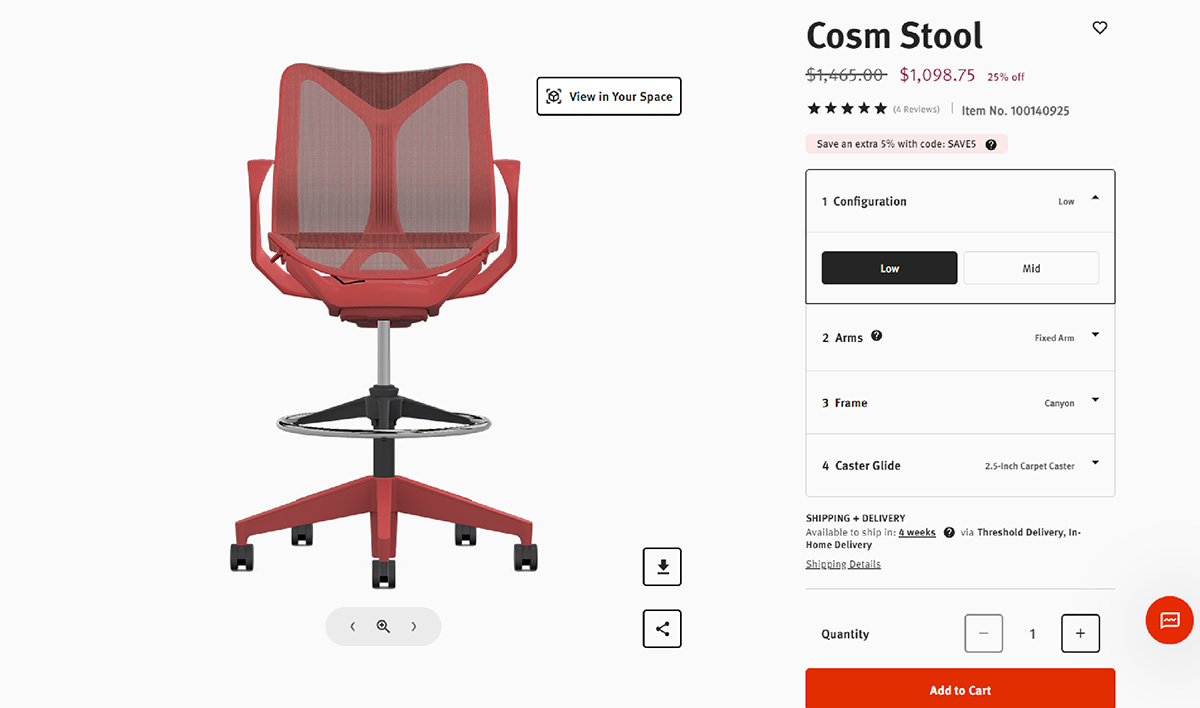
3D product configurators are designed for customizing individual items, changing the color, material, or features of a single product. La-Z-Boy, for example, supports hundreds of unique product geometries with hundreds of material options, creating the potential for four trillion possible variants. Herman Miller’s Aeron chair alone has over 16 million possible configurations.
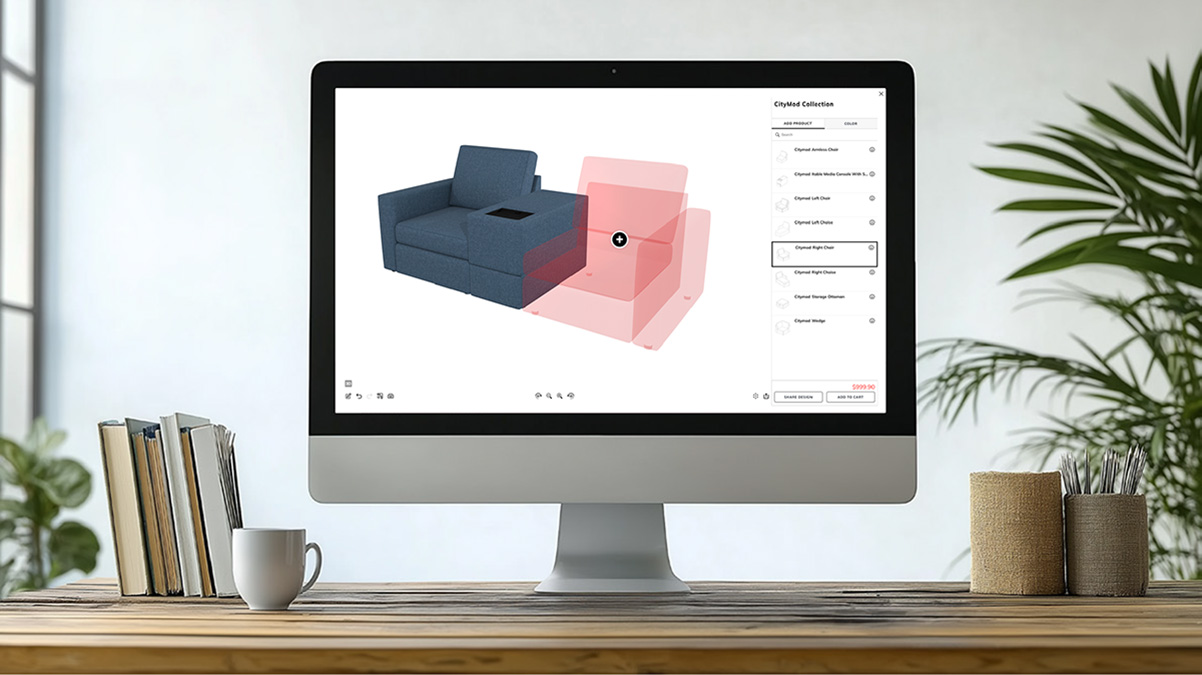
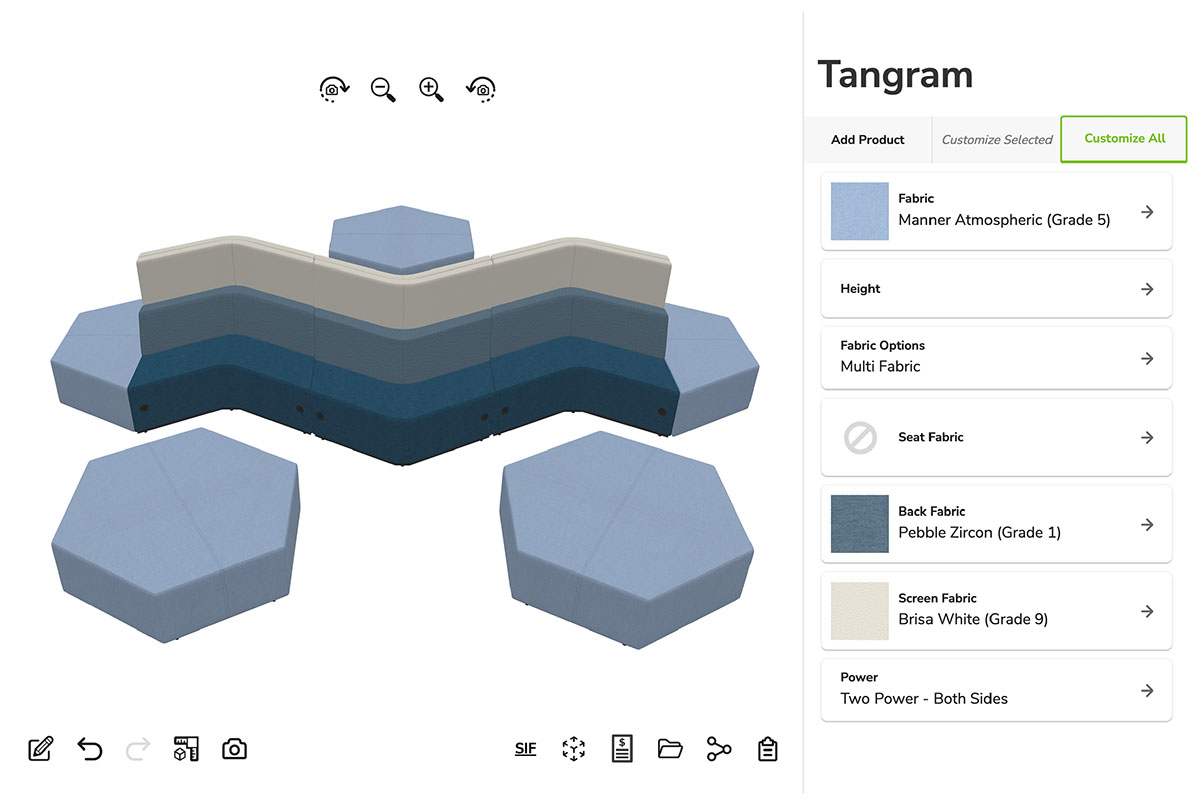
3D modular configurators handle complex product assemblies such as sectional sofas, multi-piece furniture sets, and configurable case goods, where users configure multiple elements together using detailed business rules. Retailers like American Furniture Warehouse and Raymour & Flanigan use modular configurators for sectionals, while office furniture manufacturers, including Allsteel, HON, Fellowes, and Geiger, use them for seating families and monitor arm lines.
Choosing the wrong type is one of the most common and costly mistakes enterprises make.
Key Features to Evaluate: What matters most for enterprise buyers
The most important feature categories for enterprise furniture retailers are ease of use, operational efficiency, and ROI. Here are the capabilities that matter most:
Ease of use: Enterprise configurator platforms must work for large, distributed teams without constant IT support. Look for no-code functionality that lets non-technical users launch new products, update configurations, and maintain catalogs without relying on developers. Mobile and desktop compatibility are non-negotiable. A well-run implementation should take 8–12 weeks from contract to launch.
Operational efficiency: The ability to reuse the same 3D assets across product configurators, AR, room planners, lifestyle renders, and 360° spins is what separates enterprise platforms from point solutions. Look for direct integrations with PIM, DAM, ERP, and e-commerce platforms, and for contract furniture buyers, native SIF file support to eliminate manual data entry and reduce errors.
A note on cost vs. value: Low-cost solutions often lack the functionality and flexibility enterprise companies need. Custom agency solutions can look great on the front end, but prove costly to maintain. Focus on value over price, and your 3D product configuration program will be far more successful for it.
3D Cloud Product Configurators: The leading enterprise-grade solution
With roots in digital asset management and 3D product visualization, 3D Cloud is the clear leader in 3D product configuration for home furnishings and contract furniture. The platform serves 15 of the top furniture retailers in the US and more top contract furniture manufacturers than any other 3D visualization platform. Hundreds of millions of dollars in order value flow through its product configuration applications annually.
3D Cloud stands out with its “create once, deploy everywhere” approach, allowing retailers to reuse digital assets across product configurators, augmented reality, room planners, 360° spins, HD product renders, and lifestyle renders, all from a single platform. It integrates with PIM, BOM, and payment systems, and fully supports SIF files for the contract furniture industry.
The customers:
3D Cloud customers include La-Z-Boy, Design Within Reach, Herman Miller, American Furniture Warehouse, CITY Furniture, Fellowes Brands, Kimball, Allsteel, Geiger, HON, Best Home Furnishings, Flexsteel, and Raymour & Flanigan.
“3d Cloud makes specifying products visual, fast, and easy – and it’s fully integrated with marketing order SIF files. We want to see our dealers succeed by having access to all of the possible configurations and being able to share iterations and fully customize products with clients quickly to help them com to decisions and close deals faster.”
– Todd Holderness, General Manager, Contract Interiors at Fellowes Brands
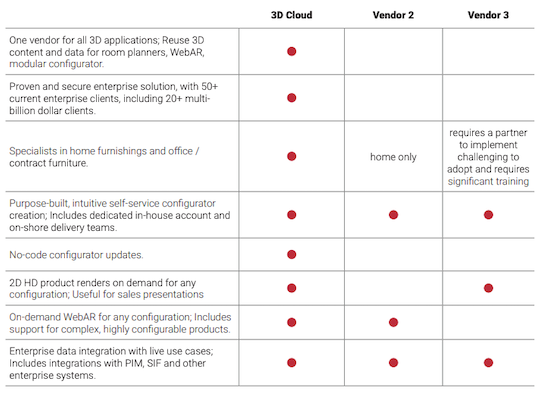
Vendor Scorecard: Quick reference guide
Get the information you need
This guide helps retailers and manufacturers understand:
- Common pain points
- Data-driven vs static solutions
- Key features and capabilities
- How others are using this tech
Download the complete 3D Product Configurators Buyers Guide