Everything you need to evaluate, compare, and choose the right 3D product rendering solution for your furniture retail business.
- Introduction: The future of furniture retail is 3D
- Why enterprise retailers need HD and 3D visuals
- Strategies for generating photorealistic product renders
- Primary use cases in enterprise furniture retail
- Key features to evaluate
- 3D Cloud Product Renders
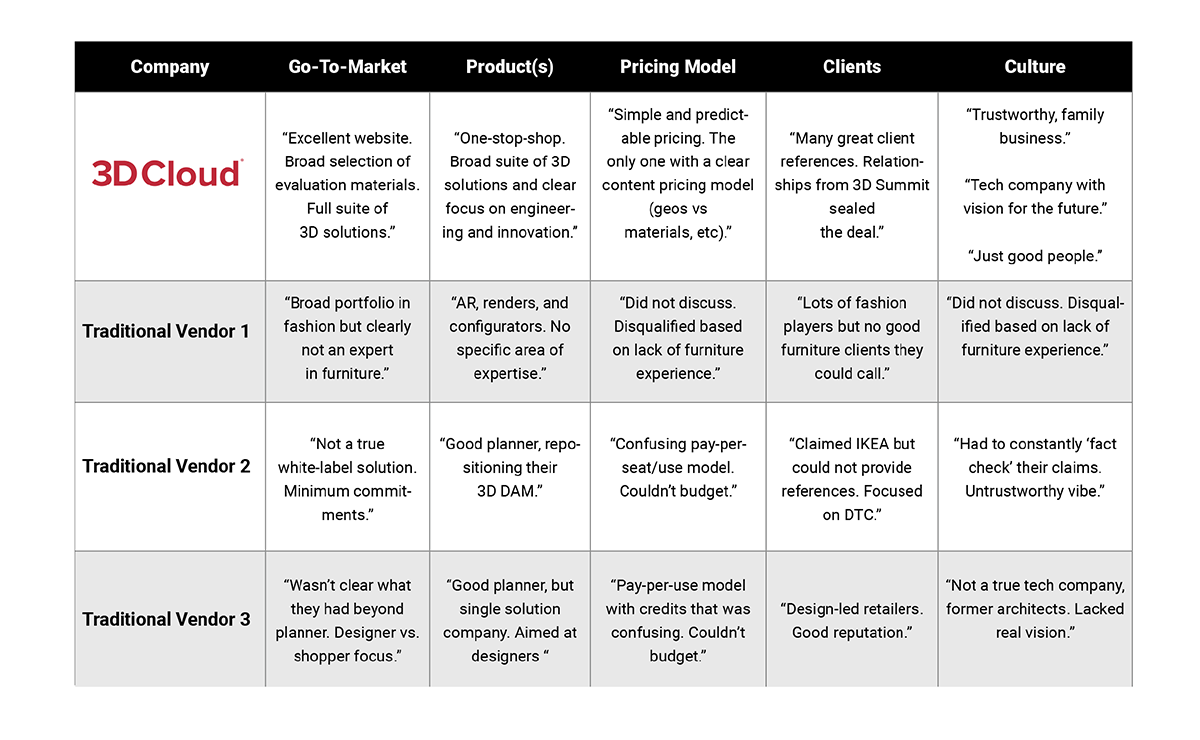
- Vendor scorecard: quick reference guide
- Download the full buyers guide
Introduction: The future of furniture retail is 3D
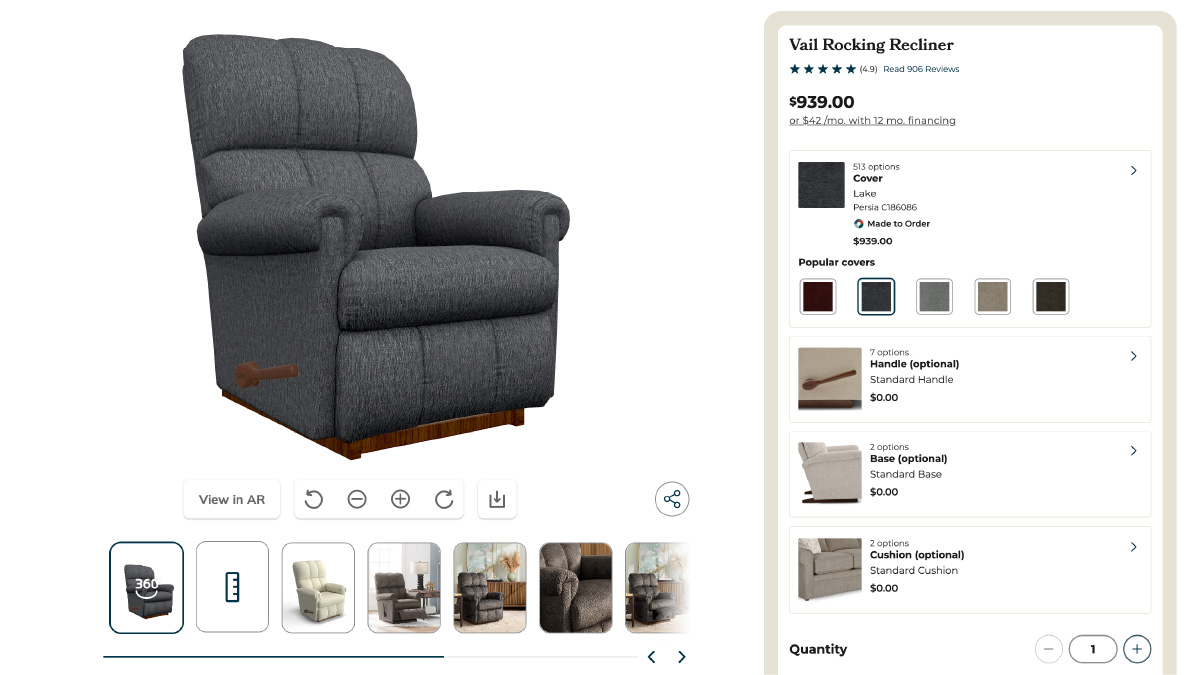
Enterprise furniture retailers and manufacturers serve a highly competitive and diverse market. To meet varied demands, 3D and HD product visualization tools have become the norm, not the exception. These modern visualization applications enable retailers to bring large, complex product catalogs to life by using photorealistic imagery. By providing buyers with fully customized product renders and realistic room designs, retailers can enhance both the in-person and virtual buying experiences.
The result? Buyers report increased confidence and a sense of control throughout the buying process, facilitating faster and larger sales.
A competitive, enterprise-grade 3D visualization strategy relies on high-quality and versatile HD product renders that reflect the full optionality of your products. In this guide, we'll review the most important features and considerations that may impact the choice of vendor for an enterprise retailer or dealer.
Why enterprise retailers need HD and 3D visuals
In the recent 3D Cloud Furniture Shopping Trends Study 2026, we found that 87% of furniture shoppers expect to view realistic product images, including their selected configurations and customizations. While many retailers accept that visualization technology is imperative, it can be challenging to deliver — especially when manufacturing or selling highly configurable and highly complex products.
Common challenges furniture retailers face include:
- Maintaining a digital catalog
- Generating HD renders
- Managing multiple vendors
- Reusing 3D content across experiences
- Executing digital merchandising
- Meeting pressure to reduce waste
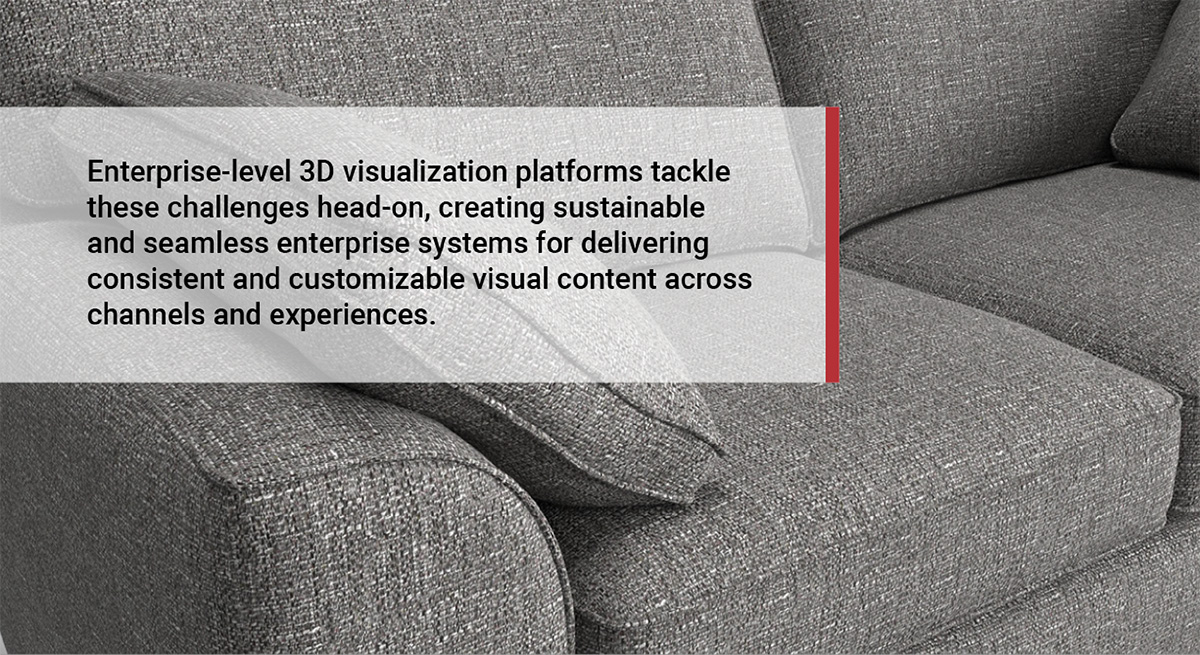
Strategies for generating photorealistic product renders
The quality of product renders significantly impacts the customer experience, regardless of whether they're shopping online or in store. Photorealistic HD renders and 360-degree render spins bring products to life, allowing shoppers to visualize and fall in love with the exact product they want to buy.
- In–house photo studios: Without a modern 3D visualization tool, retailers are forced to conduct photoshoots with real product samples. For retailers and manufacturers offering highly configurable products, it's simply unrealistic and often wasteful to fabricate physical models of every possible configuration.
- Third-party CGI agencies: To bypass these challenges, some retailers choose to hire a third party to create CGI product renders. This strategy can reflect the optionality of high-end products, but it is also expensive and time-consuming.
- HD rendering technology: Enterprise retailers and manufacturers can take advantage of a robust 3D modeling and visualization platform to generate product renders at speed, quality, and scale — quickly generating visuals that showcase the full range and optionality of your products, with easy updates for new or seasonal launches, on-demand renders, and consistent branding across 3D asset libraries.
Primary use cases in enterprise furniture retail
HD product renders are beneficial across three enterprise retail scenarios:
- Digital-first retailers (e-commerce only): 3D product renders help online-only retailers boost shopper confidence. Shoppers can customize fabrics, finishes, and more before inserting their selections into a room planner design with a digital version of their space. Branded tools keep customers engaged through checkout.
Example: An online sofa retailer lets shoppers configure a sectional, test fabrics, and see it in a virtual living room before ordering.
Key benefit: Higher online conversion and reduced purchase hesitation
- Omnichannel retailers (online + in-store): Retailers with both stores and digital channels benefit from using the same 3D tools online and in-store. Customers can browse from home, while sales associates can design with customers on a tablet or kiosk, configuring sectionals, tables, and other modular products in-store and in real-time. Retailers can also track sales attribution, linking online design activity to in-store purchases to optimize the sales journey.
Example: After a customer leaves the site without buying the armchair they customized, the customer success platform automatically sends them a series of reminder emails urging them to complete their purchase.
Key benefit: Increased sales and better insight into the customer journey
- Free design services (pro-assisted shopping): Retailers offering complimentary design services use inspirational 3D product renders with pro tools for lighting, finishes, and angles. Designers can then create digital replicas of the customer’s space, inserting the customized products and presenting a fully styled plan. This personalized experience drives larger purchases.
Example: A customer who comes in for a sofa might leave with a complete living room set, including rug, lamps, and coffee table.
Key benefit: Higher average order value through complete-room upsells and an inspirational in-store shopping experience
Key features to evaluate
To help you select the right 3D product rendering solution for your needs, let’s explore the most
important features and capabilities that an enterprise-grade platform should provide. These
Include:
- High-quality renders with customizable dimensions
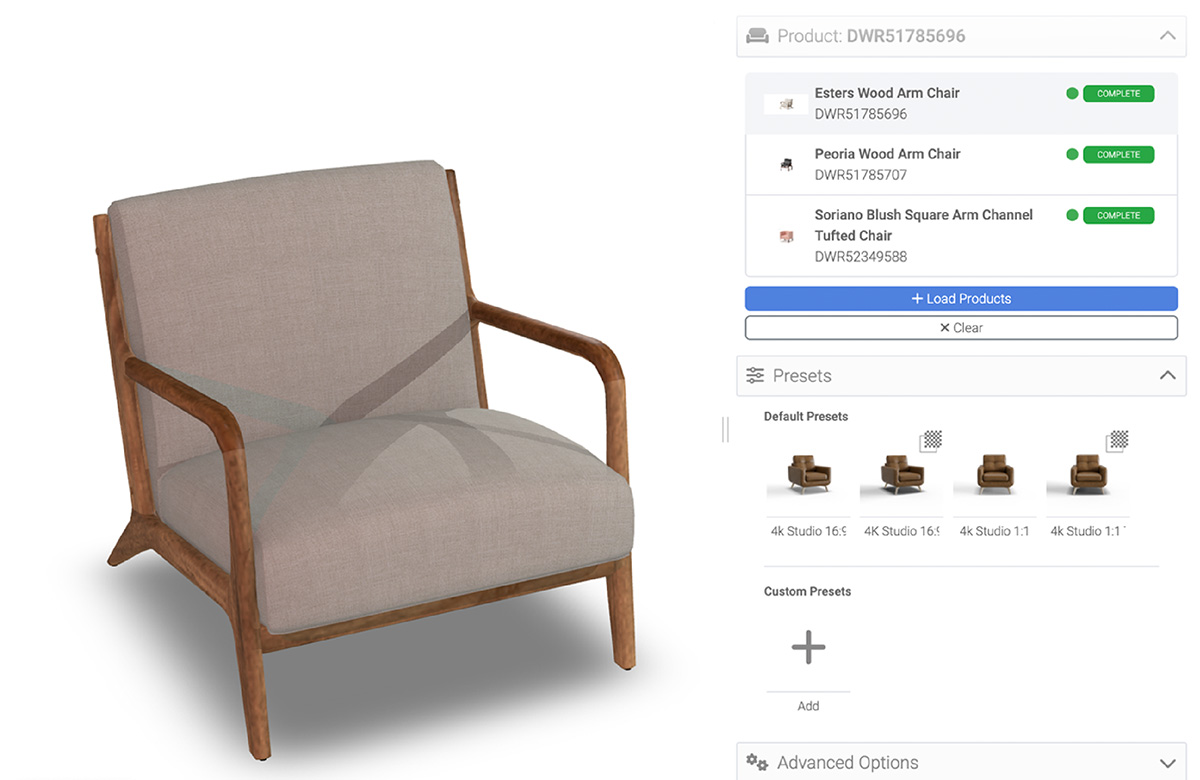
- Dynamic lighting and camera controls with customizable presets
- Single HD renders on demand
- Bulk HD renders
- 360-degree spins (pre-rendered)
- Tool versatility and streamlined integrations
3D Cloud Product Renders
With roots firmly in 3D product visualization and enterprise digital asset management, 3D Cloud has become known as the leader in 3D product configuration and visualization for the home furnishings and contract furniture industries — supporting many of the top 50 furniture retailers in the US, including La-Z-Boy, CITY Furniture, Raymour & Flanigan, and American Furniture Warehouse.
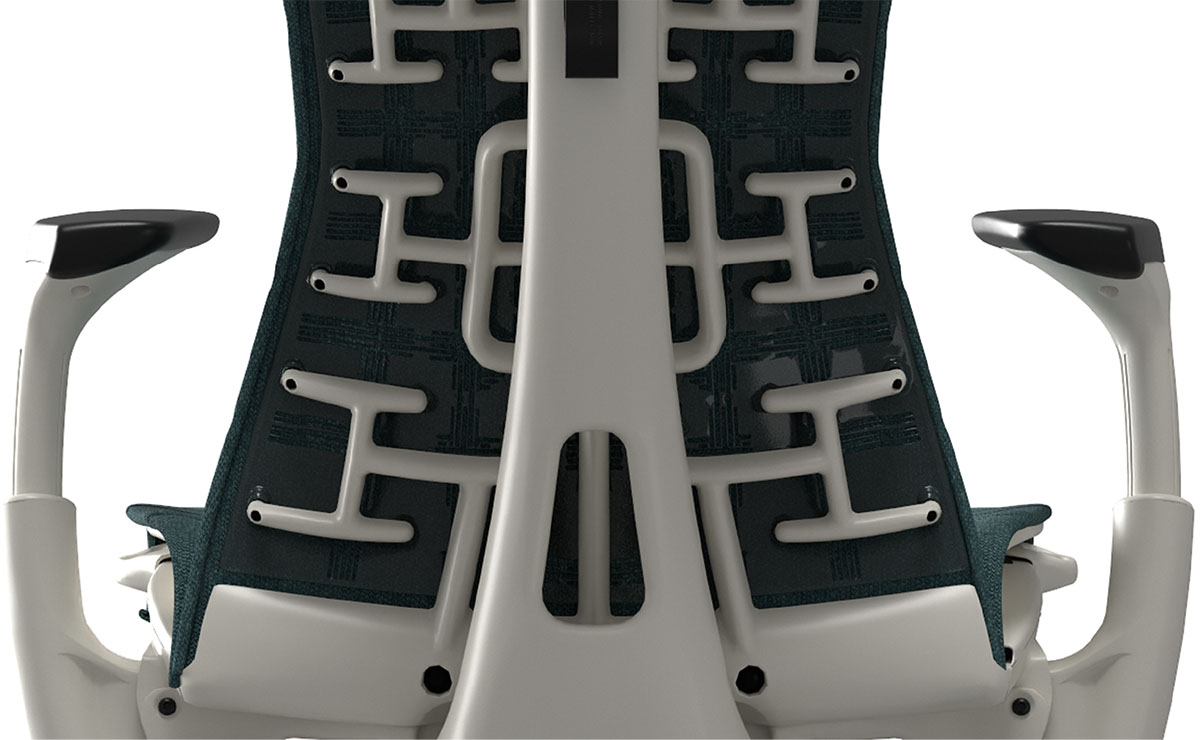
3D Cloud Product Renders were designed specifically for the highly configurable and complex product catalogs of enterprise retailers. The platform delivers a 50% increase in visualization output and up to a 90% per-image cost reduction — all without adding headcount. Key capabilities include fast time-to-value, no-code DIY rendering tools, powerful presets, effortless scalability, streamlined workflows across the full 3D Cloud application suite, and advanced realism in lighting and materials.
"The 3D Cloud Platform offers a single source of truth, making it easy for us to manage and deploy 3D content across applications"
- Katharine Martin, Senior Site Merchandiser for Raymour and Flanigan
Vendor scorecard: quick reference guide